Self-Service PortalE1
Public web at /public/. Travelers search found items by photo + report lost items themselves. Rate-limited, CAPTCHA, claim-code tracking — no staff in the loop.
A mobile app + a manager dashboard, joined to a stack of AI services that handle the daily flow of ground operations: item-check decisions, live interpretation, X-ray training, remote expert assistance, child protection, lost-and-found, scheduling, incident reporting. Built for staff who can't pause to read a manual.
Checked against the regulation database, AI vision and real-time web search · confidence 0.96
Auto-assignment reassigned 2 shifts; pre-shift briefing pushed at 06:00 with acknowledgement 96%.
Live speech-to-text + AI translation · secure streaming · captions in ~1 s
Hero AI features
The AI is not a back-office optimisation. It runs in the staff's pocket — on the mobile app — and on the live video feed when an expert is helping. Designed so a busy ground-staff member can use it one-handed.
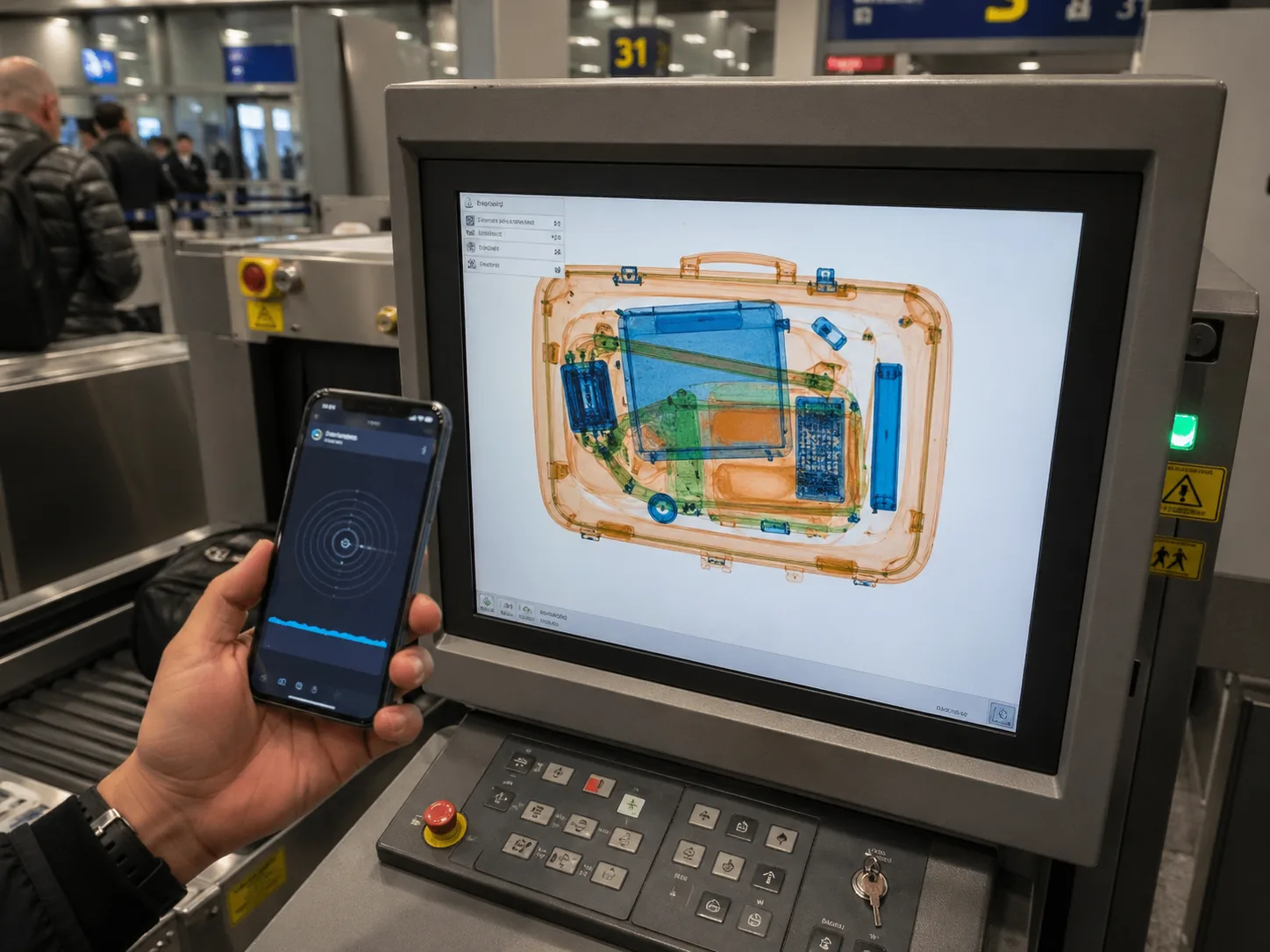
Photograph an item or describe it. The system runs a priority cascade over its own sources — a curated regulation database (seeded from Japanese MLIT dangerous-goods guidance and IATA / ICAO item typology), a web-search-learned database, image matching against a training library, AI vision, and a real-time trusted web search — then AI reasoning reconciles the best match and returns a per-dimension verdict (cabin / checked / import / export, each allowed / conditional / prohibited) with a confidence score.
Gamified prohibited-item detection. Staff annotate items with bounding boxes, the system scores with IoU + streak bonuses. Annotations export as training datasets to improve the AI model — the trained model then assists staff in real X-ray screening. A virtuous cycle: better annotations → better model → easier shifts → more annotations.
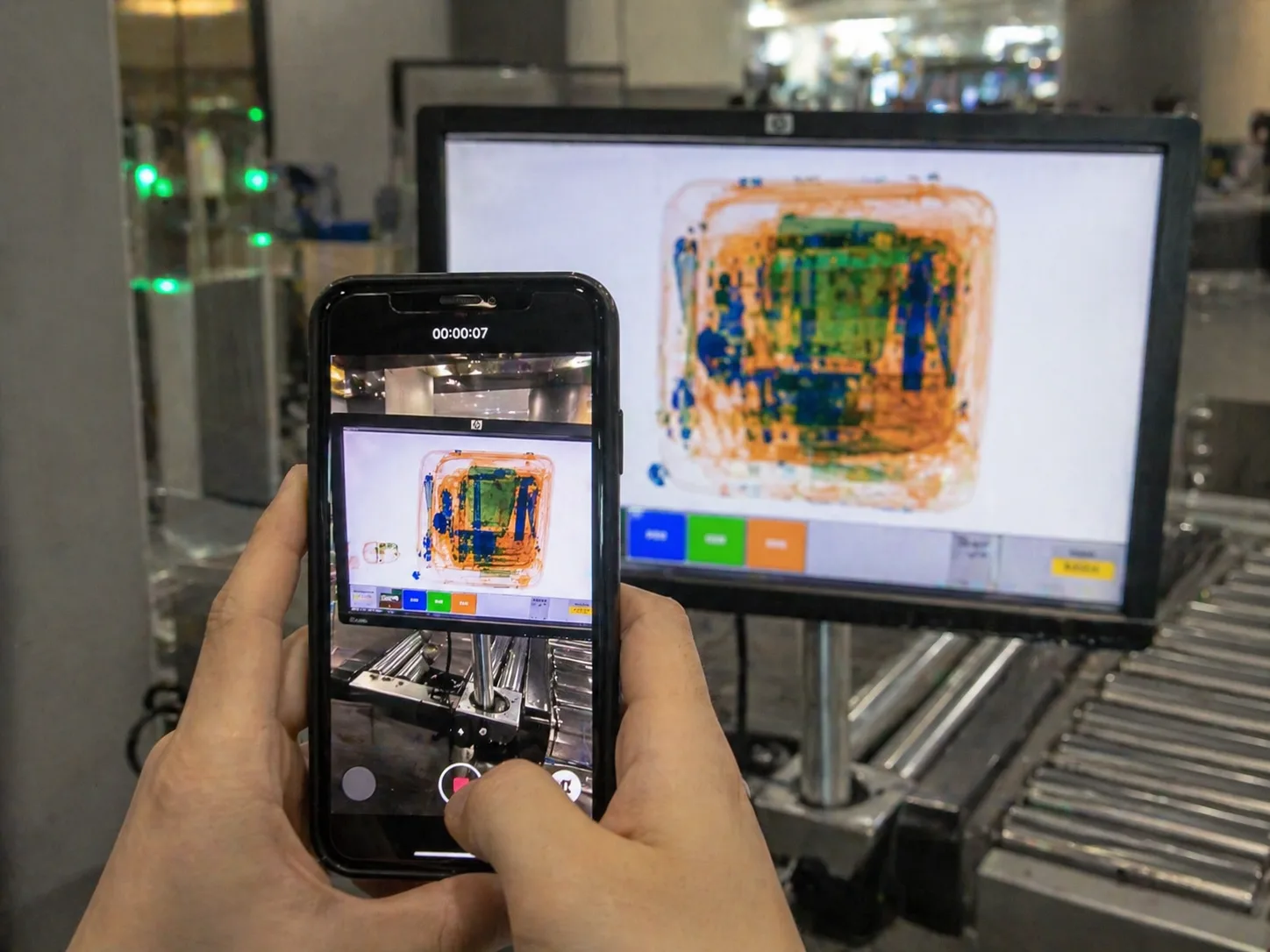
Field staff streams the phone camera to an off-site expert over encrypted live video. The expert annotates the feed with arrows, highlights, and notes that sync live to the staff member's screen. On a captured frame, AI object detection flags items the expert might miss. Tested across cellular and on-site Wi-Fi.
Real-time speech-to-text and AI translation. Japanese / English / Traditional Chinese. Audio streams securely to the backend, is transcribed and translated, and the result returns as live captions — partial text in about a second, final in about two. Template-phrase library for common ground-staff scenarios. Tested at noisy gates and on the apron.
See it in action
Two of the four AI hero features run on top of the physical airport — the AI Item Check phone in the staff's hand at the X-ray station, and the Remote Expert Assist phone recording the X-ray monitor. Drag each slider below to compare the raw scene with the AI / expert overlay layered on top.
Smart Scheduling
Auto-assignment matches every staff member's submitted availability against each location's requirements and required qualifications, fills the week in seconds, and surfaces the few cells that need a manager's call. Pre-shift briefings auto-queue with acknowledgement once the schedule is approved.
Lost & Found · 14 features
A comprehensive system, not a form. Multi-photo capture with AI vision item-naming + AI 3-language descriptions (JA/EN/ZH-TW) + AI image-similarity search + a strict 3-UUID match-event protocol that prevents orphan handovers + 58 mm QR labels printed from mobile + a self-service traveler portal + email escalation to police/airport authority + a map heatmap.


残り 5 件 · 受取人到着待ち
Found Item (LF:uuid) and Seeker Report (SR:uuid) are independent until staff create a Match Event (MH:uuid). Handover cannot proceed without one — guarantees no orphan returns.
matched → handed_over via "Process Handover" with signaturematched → withdrawn reverts both records to found_reported / lost_reported for re-matchingCustomer shows a photo of their lost item; staff snaps it; AI image embedding ranks candidates. Description similarity is scored in both Japanese and English — the higher score wins, so a Japanese-only seeker still matches an English-only item.
Public web at /public/. Travelers search found items by photo + report lost items themselves. Rate-limited, CAPTCHA, claim-code tracking — no staff in the loop.
Mobile print module. Renders a 58 mm QR label at 203 DPI (464 px) and prints via the OS print dialog — any AirPrint / Mopria / Wi-Fi / USB printer, or save as PDF. Label carries UUID, item name, multi-language footer.
A background worker checks every 60 s. When elapsed time exceeds an external contact's threshold (police, airport authority), an email is sent — once per contact per event. Audit log of every send.
map heatmap overlay on the staff GPS map. Toggle Lost Items / Incidents · Today / 7 d / 30 d. Hotspot panel surfaces top locations + week-over-week trend for ops review.
Twenty more workflows
The four AI capabilities above are the headline. They sit inside a much larger operations platform — twenty more daily-use modules, all built into the same mobile app, all reflected on the manager's web dashboard. Authentication / people / equipment / scheduling / communication / compliance / utilities — every flow ground staff actually runs through in a shift.
Face recognition as a sign-in factor (alongside ID/password, fingerprint, employee card). Liveness-checked. Fast sign-in.
Every staff action recorded to a personal activity history — reviewable in-app and on the dashboard, timestamped and GPS-stamped.
AI registration of unaccompanied minors from photo + voice. Natural-language search, guardian-handover tracking, full audit log.
AI image-similarity search + 58 mm QR labels printed from mobile. Visual status tree from intake to return.
Real-time messaging — per-airport rooms + 1-on-1 channels. Read receipts, image share, reactions & stickers.
Internal photo / video feed for ground staff — shift moments, recognition, equipment tips. Double-tap to like.
AI-summarized aviation security news from RSS / HTML sources. Multi-language. Reviewed on the dashboard, surfaced in the home briefing.
Rule-based auto-assignment on availability + qualifications, check-in / check-out, GPS location, pre-shift briefings with acknowledgement.
Document handoffs with photos, equipment status, and sign-on / sign-off acknowledgement.
Multi-step wizard with severity levels, photo evidence, and investigation workflow with audit trail.
4-step wizard: photo → item lookup → passenger signature → PDF. Regulator-grade evidence chain.
Searchable encyclopedia of restricted items with country variants. Linked from Item Check verdict.
Every action timestamped + GPS-stamped. Replayable on a terminal map for incident review.
Live flight status, gate assignments, delays — pulled from an external flight-data feed, cached server-side, filtered to your terminal.
Current conditions, hourly outlook, and severe-weather alerts for the airfield. Critical for ramp ops.
Asset register for machines, headsets, scanners — type, status, assigned location, and maintenance logs.
Push regulatory bulletins, SOP updates, training PDFs. Read-receipt tracking per staff member.
Briefing-room whiteboard accessible from every device. Supervisor sketches the day's plan; staff annotate live.
Lock, wipe, reboot, and kiosk-lock enrolled devices. Online / offline status with last-sync per device.
Per-staff home: today's shift, briefing acknowledgement, news headlines, weather, badge status — single screen.

Manager dashboard
Web dashboard for managers and supervisors. Staff assignment calendar, auto-scheduling controls, real-time stats, MDM device management, interpretation session monitoring, news management, audit tools with GPS map.
One platform
Mobile app, manager dashboard, and AI services are engineered together as a single system — so item-check, interpretation, lost & found, scheduling, incident reporting and audit all share one login, one data model, and one audit trail. Every capability is modular, auditable, and explained to your security team in plain terms.
LV3 handles installation, MDM enrolment, country-specific regulation seeding, and team training. From pilot to full operations in weeks.
check-inBiometric sign-in. The staff app supports several login factors — ID/password, fingerprint, face recognition, and employee card; face is one of them, liveness-checked. Fast sign-in in the field.
logsEvery action a staff member takes is recorded to a personal activity history — item checks, sign-ons, handovers, incidents — each entry timestamped and GPS-stamped. Staff review their own day in-app; managers see the same record on the dashboard.
kidRegister and track unaccompanied or separated minors. Voice-first registration, AI parsing of clothing / features from the photo, natural-language search, critical push to every device on duty, and a guardian-handover protocol with photo evidence and timed escalation. Wristband pre-registration (E2) lets staff pre-register children at security counters when families opt in.
lostThe full life-cycle — registration, seeker report, image-similarity search, match event, handover, expiry, transfer, withdrawal, incident — plus a self-service traveler portal, email escalation, and a heatmap. The featured section above is the visual; this is the reference checklist.
staff-chatReal-time messaging built into the same app. Per-airport public rooms (auto-joined on shift), private 1-on-1 rooms, and reaction / sticker support. Real-time fan-out; messages persist and are searchable.
airgramAn internal photo / video feed — Instagram for ground staff. Used for shift moments, recognition, equipment tips, found-item shoutouts. Increases morale and surfaces tribal knowledge that would otherwise live only in the break room.
Aviation security and industry news, collected from RSS / HTML sources (official Japanese gov feeds), summarized by AI and translated. A backend collector plus a dashboard review step; published summaries surface to staff in the home briefing.
staff-assignFive linked data models — AirportLocation, LocationRequirement, LocationRequiredQualification, StaffAvailability, StaffAssignment — fed into a rule-based auto-fill algorithm (redistribute overstaffed slots, then fill by availability, filtered by qualifications and sorted by training score). Staff submit availability once; managers approve in seconds; conflicts surface as amber cells.
handoverStructured handoff between outgoing and incoming staff. Every shift ends with a card: open incidents, equipment status, lost-item queue, task checklist — anything that needs attention. The incoming staff member reads and acknowledges before the shift is fully transferred.
incidentVoice-first incident capture. Staff hold the phone, describe what happened, take photos, and the system fills the form. Severity ladder (low → medium → high → critical, each with an SLA target) routes to the right escalation chain. Investigation workflow tracks the record to closure.
seizureConfiscation evidence chain — regulator-grade. Four steps: photograph the item, look up the regulation that justifies the seizure, capture the passenger's signature, generate a PDF with all metadata and a unique seizure-record ID. Designed so an auditor reading three years later can reconstruct the moment.
glossarySearchable encyclopedia of restricted items, with country-specific overrides. Every Item-Check verdict links here for the regulation citation. Staff can also browse during downtime to keep edge cases fresh.
/audit/ (TOTP-protected)Every action — every item check, every sign-on, every seizure, every chat message — is timestamped and GPS-stamped. Replay any incident on a terminal map: where the staff member was, what they did, who they talked to, in chronological order. Audit dashboard sits behind TOTP.
/audit/ entryflightsLive flights filtered to the staff member's terminal — gates, delays, expected arrival times. Data is fetched periodically from an external flight-data feed and cached server-side; the app reads the cache, and a fallback source keeps it populated if the primary is unavailable.
weather · external weather feedWeather for the airfield — current conditions, an hourly / daily forecast, and severe-weather alerts, pulled from an external weather feed and cached server-side. Critical for ramp ops, baggage handling, and any outdoor work that can be paused for wind / lightning.
equipmentA register of shared machines and assets — type, status, and the location each is assigned to. Maintenance is logged per asset (inspection, repair, condition change) with a next-maintenance date, and every status change is recorded as an event. Feeds the scheduling engine, which won't staff a location whose required machine isn't available.
pdfPush regulatory bulletins, SOP updates, and training PDFs to staff phones. Each document tracks per-staff read receipts so a manager can prove that everyone on shift has acknowledged the new rule before the regulator asks.
syncpadSynQ Pad is a live camera-and-canvas sharing engine; the briefing-room whiteboard is one use of it. Supervisor sketches the day's plan on a tablet; every staff phone shows it live. Strokes persist across reconnects; participants can annotate.
Every enrolled phone runs in kiosk mode (Android Device Owner) with only allowed apps visible. Lock, wipe, and reboot commands run from the dashboard; devices sync their configuration and apps from the enrollment profile. Online / offline status with last-sync surfaces problems before staff hit a shift.
index (default landing screen)The staff member's home screen — the first thing they see when they open the app. Configurable menu grid + the day's headlines: today's shift, briefing acknowledgement state, top news, weather, badge / equipment status — one screen, no scrolling.